“Carrying out Śrīla Prabhupāda’s Order”
The GBC as ISKCON’s Ultimate Managing Authority
Introduction
The beginning of this paper takes us to Vrindaban in the early 1960s. We see Śrīla Prabhupāda sitting alone in his rooms at the Rādhā-Dāmodara temple. He is looking out at the samādhi of Śrīla Rūpa Gosvāmī and meditating on the state of his spiritual master’s mission: what it had been when his Guru Mahārāja was present, what it was meant to become, and the sad state it had fallen into. Later on he would write in the Caitanya-caritāmṛta:
“Bhaktisiddhānta Sarasvatī Ṭhākura, at the time of his departure, requested all his disciples to form a governing body and conduct missionary activities cooperatively. Despite the spiritual master’s order to form a governing body and execute the missionary activities of the Gauḍīya Maṭha, the two unauthorized factions began litigation that is still going on after forty years with no decision.” [Ādi-līlā 12.8, purport]
Śrīla Prabhupāda felt great pain when he considered how his spiritual master’s once-powerful mission had been shattered by party spirit, individual ambition, distraction by material facility, and loss of the spirit of cooperation. His analysis was that a key cause of the collapse of the Gauḍīya Maṭha’s united efforts was their failure to follow the order of their spiritual master. The day before his departure from this world, Śrīla Bhaktisiddhānta Sarasvatī Ṭhākura had instructed his followers:
“Form a governing body of 10-12 persons for managing the mission’s work.” [December 31, 1936. Recorded by Bhakti Pramode Purī Mahārāja / Bhaktivedanta Research Centre]
Śrīla Prabhupāda was also meditating on executing his own instructions from his spiritual master: to take the message of Caitanya Mahāprabhu to the West. He foresaw the mission of his spiritual master reinvigorated into a powerful worldwide mission carrying the mercy of Lord Caitanya to every town and village.
As he told Mr. Ruben, one of the acquaintances Śīla Prabhupadaā made in his early days in New York City;
Mr. Ruben: “He seemed to know that he would have temples filled up with devotees. He would look out and say, “I am not a poor man, I am rich. There are temples and books, they are existing, they are there, but the time is separating us from them.” [December, 1965, Līlāmṛta, Chapter 15]
Srila Prabhupada printed on his business card “Branches around the world”
In Śrīla Prabhupāda’s heart, in seed form, were all the aspects of Śrīla Bhaktisiddhānta Sarasvatī Ṭhākura’s mission. One by one, by his tireless efforts over the following years, Śrīla Prabhupāda gave those desires of his Guru Mahārāja form and function via his ISKCON, the
vehicle he crafted to carry out book publication and distribution, expansive harināma, diorama displays, exquisite Deity worship, opulent prasādam distribution, farm communities, gorgeous public festivals, and bold preaching challenging to its core the mundane view of the world and our purpose in it.
Śrīla Prabhupāda’s vision, the re-manifestation of his spiritual master’s own vision, was of a vibrant society, with many strong persons all working under the umbrella of the same institution. Śrīla Prabhupāda meditated long and hard on how to keep his new society united. How in the future, when there would be many powerful devotees with their myriad projects and followers, to keep them all under the same umbrella? How to avoid the party spirit of the single-ācārya view that so ravaged the Gauḍīya Maṭha? How to have a firm yet flexible structure that allows for unity in diversity?
Śrīla Prabhupāda’s solution was the same as his Guru Mahārāja’s—to form a governing body to manage his ISKCON.
What follows is the history of Śrīla Prabhupāda’s implementation of the GBC principle, as well as an explanation of the scope and scale that he intended it to have.
Śrīla Prabhupāda implements the GBC principle
From early on, Śrīla Prabhupāda was considering implementing a governing body to help supervise his Society:
“In my idea, there should be one central body of trustees for directing all the different centers ” [Letter to Kīrtanānanda & Hayagrīva, August 23, 1968]
“In the future we can form a central governing body for the whole institution.” [Letter to Tamāl Krishna, October 18, 1969]
“You have asked about the management of our society, and the position is that management should be done in such a way that people may not break away. That is the first business of management. I have already explained the matter to you and Tamala, so you do it consulting amongst yourselves, gradually coming to the general governing body for managing the whole affairs.” [Letter to Brahmānanda, October 28, 1969]
“I think we should have a central governing body for dealing with important matters.” [Letter to Brahmānanda, June 19, 1970]
During the July 1970 San Francisco Ratha-yātrā, at Śrīla Prabhupāda’s request, the American temple presidents held an organizational meeting.
“Śrīla Prabhupāda asked the many temple presidents assembled for the Ratha-yātrā to meet and discuss forming a governing body to manage ISKCON. The devotees met and then reported that they thought only one of them should be elected the chief representative.” [Līlāmṛta, Chapter 31]
“They hadn’t understood. The strength should be in a group, Śrīla Prabhupāda said, not in a single individual. Since he was ISKCON’s founder-ācārya, what need was there for another single leader?” [Līlāmṛta, Chapter 31]
In response, Śrīla Prabhupāda had a document titled “Direction of Management” drawn up.1 After giving a short history of his activities since coming to America, along with a list of the
temples existing at that time, the “Direction of Management” states:
“As we have increased our volume of activities, now I think a Governing Body Commission (hereinafter referred to as the GBC) should be established. I am getting old, 75 years old, therefore at any time I may be out of the scene, therefore I think it is necessary to give instruction to my disciples how they shall manage the whole institution.”
Śrīla Prabhupāda went on to name twelve of his senior disciples, stating:
“These personalities are now considered as my direct representatives. While I am living they will act as my zonal secretaries, and after my demise they will be known as Executors.”
In spelling out their duties, the first clause states:
“The purpose of the Governing Body Commission is to act as the instrument for the execution of the Will of His Divine Grace. And further, the GBC oversees all operations and management of ISKCON, as it receives direction from Śrīla Prabhupāda and His Divine Grace has the final approval in all matters.”
The document goes on to describe the process for selecting GBC members, as well as their terms of office. It was then witnessed and signed on July 28, 1970.2 Thus, carrying on with the vision of his spiritual master, Śrīla Prabhupāda launched ISKCON’s own Governing Body Commission, or “GBC”.
Śrīla Prabhupāda wasted no time implementing his new system. Only nine days after signing the “Direction of Management,” he wrote:
“Now I have set up the Governing Body Commission to handle management, questions of philosophy, and personal problems.” [Letter to Upendra, August 6, 1970]
1 The “Direction of Management” document will be discussed at greater length elsewhere in this paper.
2 For more on this topic see the section entitled “Election of GBC Members.”
Ten days later he wrote:
“So now the factual administration will depend on the Governing Body Commission and the sannyasis are entrusted for making propaganda work. I wish to remain on the background to give you some directions.” [Letter to Bali-mardana, August 16, 1970]
The message above became a steady drumbeat as he trained his disciples to follow the system he was putting into place.
Toward the end of the year, Śrīla Prabhupāda wrote to the GBC members themselves:
“I have received the report of Pittsburgh GBC meeting. I am happy to see you all so active and serious about carrying on the work which I have started. Now I want that all administration may be done by all of you 12 GBC members all over the world.” [Letter to Karandhara, November 30, 1970]
1971 carried on in the same tone as SriŚīla Prabhupadaā continued to train his GBCs and followers around the world.
“It is good that you GBC members are meeting and conjointly discussing such things as life membership, book distribution, etc. The future hope of solid standing of our mission is on the proper management of our governing body.” [Letter to Bhagavān, February 16, 1971]
“It is proposed by the 15th September a meeting of GBC will be held there. We require to hold this important meeting of the GBC to formulate the rules and regulations how things will be worked on.” [Letter to Tamāl Krishna, August 14, 1971]
(See Appendix A for the full text of the “Direction of Management” document.)
Not a smooth or easy road
However, 1972 showed that Śrīla Prabhupāda was not going to have a smooth or easy road training his fledgling GBCs. As he would write later on:
“Of course you GBCs are in training.” [Letter to Karandhara, March 15, 1973]
And much training was going to be needed as the GBC principle and practice unfolded. As the temple presidents had misunderstood Śrīla Prabhupāda’s intent going into their 1970 meeting at the San Francisco Ratha-yātrā, without the protection of following proper procedure, some GBCs held a meeting in New York in March of 1972 and made decisions displeasing to Śrīla Prabhupāda. Obliged to step in, Śrīla Prabhupāda wrote:
“I have just now received one letter which has described your GBC meeting of nine men in New York, and I have cabled Rupanuga the following message: ‘GBC Meeting irregular. My strong disapproval. Make no changes.’
“The meeting of the GBC appeared to be very unconstitutional, because all the men were not informed or invited. Syamasundara was not invited, Sudama was not invited, Krishna das was not invited, Tamala Krishna was not invited, neither I was informed. Why? You cannot hold meeting of 8 persons without inviting the others. Seven may be a quorum, that’s all right, but you cannot convene without a general announcement to all the members and myself, giving a proposed agenda, like that, the topics to be discussed, why the meeting is being called, etc. Then there is correspondence for deciding these things, and if there is great necessity, then meeting may be called, but not whimsically, only after much thought is given and there is clear intimation of all the members plus myself. [Letter to Haṁsadūta, April 2, 1972]
Śrīla Prabhupāda suspended the GBC temporarily and told his temple presidents to carry on independently “until I thoroughly revise the whole procedure.”
But after rectifying the situation, Śrīla Prabhupāda carried on with the GBC principle undaunted. A few months later we find him writing:
“Now I want all of you to work cooperatively and very frankly, that is our process, not that we shall always plot and scheme and write letters. Madhudvisa is GBC man for South Pacific zone, so his direction must be followed by everyone and all of the devotees there should address their problems to him for his consideration.” [Letter to Madhudviṣa and Amogha, August 24, 1972]
“The GBC authority must be accepted under all circumstances, not that there will be fighting amongst you.” [Letter to Bali-mardana and Puṣṭa Kṛṣṇa, September 18, 1972]
Śrīla Prabhupāda closed out the year:
“So far your question, how far should the orders of my duly appointed officers like GBC, etc., be obeyed and followed, the answer is that they must always be followed exactly as he says. Have you not heard me on this point? Why these questions are repeated again and again?” [Letter to Jayadharma, December 13, 1972]
A new threat: Spiritual authority alone is not always enough
The year of 1974 saw a new and grave threat. The temple president in Hawaii left ISKCON, sold the temple, and kept the money. There was the threat of the same thing happening to the temple in Auckland, New Zealand. Śrīla Prabhupāda understood that in some situations his spiritual authority as ISKCON’s founder-ācārya would not be enough to safeguard the assets he and the devotees had worked so hard to build up. Śrīla Prabhupāda responded strongly, immediately moving to put into place legal safeguards to help prevent such events from ever happening again.
Having his secretary contact all ISKCON temples, Śrīla Prabhupāda sent out a directive dated July 22, 1974, titled “TOPMOST URGENCY.” It ordered that amendments immediately
be added “to all official registration documents, constitutions, incorporation papers, etc.”
“In particular it shall be clearly understood that no real estate may be purchased or sold by any officer of the Society without the express permission of His Divine Grace A.C. Bhaktivedanta Swami Prabhupāda, the Founder-Acarya of ISKCON. . . .
“There shall be a Governing Board Committee of trustees appointed by the Founder-Acharya His Divine Grace A.C. Bhaktivedanta Swami Prabhupāda according to the document Direction of Management dated July 28, 1970. The GBC is to act as the instrument for the execution of the will of His Divine Grace Śrīla Prabhupāda.”
It is imperative to note that Śrīla Prabhupāda wanted it specifically recorded that the GBC was to act as Śrīla Prabhupāda’s legal agents in protecting ISKCON’s properties.
Śrīla Prabhupāda’s pattern of insisting on having legal protection for properties was confirmed in his instructions regarding ISKCON in Fiji. On November 25, 1974, he wrote to Subala Mahārāja, one of his representatives in Fiji:
“Regarding your registration, it should be clearly stated that no property can be sold or mortgaged without my express sanction.”
Following up, Śrīla Prabhupāda wrote to Vāsudeva Dāsa:
“Before the finalization of registration takes place I would request you to send me one copy of the constitution for our society there so I can approve it finally. My name should be there as the founder-acharya, A.C. Bhaktivedanta Swami. I should have full authority in all matters.” [December 29, 1974]
A few months earlier Śrīla Prabhupāda had written:
“Regarding the International Trust Board, we are now expanding and so our interests should be carefully guarded. Certainly the 12 GBC members are being trained up strictly under my guidance so that they will protect the interest of the society very, very carefully. All our property should be well protected, and I think in every document my name as Founder-Acarya should be mentioned. Special care should be taken that no property can be sold or mortgaged by local managers as was done by Gaurasundara. This is my only concern.” [Letter to Bali-mardana, September 5, 1974
In 1976 Śrīla Prabhupāda was obliged to step in again regarding the Fiji situation:
“In connection with our ISKCON project in Fiji, I beg to inform you that we are managing our Krsna consciousness movement by the Governing Body Commission, GBC. We have got about 20 GBCs looking after the whole world affair, and above the GBC I am there. Below the GBC there are the temple president, secretary, treasurer in every centre. So the temple president is responsible to the GBC and the GBC is responsible to me. In this way we are managing. . . .
“The deed for the property and temple should be made in favor of ‘His Divine Grace
A.C. Bhaktivedanta Swami Prabhupāda, founder-acharya of the International Society for Krishna Consciousness.’ It cannot be dedicated to any of the office bearers.” [Letter to Vāsudeva Dāsa, June 30, 1976]
“If you want to consider this project as an ISKCON project then you must abide by the orders and direction of the GBC, which you do not like to do.” [Letter to Vāsudeva Dāsa, July 29, 1976]
Śrīla Prabhupāda went so far as to write directly to the manager of the bank in Fiji, instructing, in his capacity as the “final authority on all ISKCON matters,” not to give any loans to ISKCON Fiji unless he received Śrīla Prabhupāda’s direct authorization:
“In regards the loan of $80,000.00 solicited by Deoji Punja in the name of ISKCON, or any other loans solicited in the name of ISKCON, as the Founder-Acarya and final authority on all ISKCON matters please be informed that until you receive authorization from me you may kindly wait in these matters of loans until further notice from me.” [Letter to Mr. B. J. Murdock, July 29, 1976]
Two points are made clear by the above letters. The first is that Śrīla Prabhupāda definitely wanted to personally have legal control, and the second is that he intended the GBCs to act as his agents in this regard.
(See Appendix B for the full text of the “Topmost Urgency” memo.)
Protecting Properties
Srila Prabhupada’s concern over protecting ISKCON’s properties did not end with the resolution of the Hawaii or Fiji situations. Rather, it weighed on his mind up until his last days in Vrindaban. The follow excerpt from the Lilamrita confirms this.
Srila Prabhupada had already given the outline for his Will to Tamala Krsna Goswami: The
G.B.C. would be the ultimate governing authority in ISKCON. Three trustees would be assigned to each ISKCON property. The money in Prabhupada’s name in various banks would become ISKCON’s property. A small pension would be allowed for his ex-wife and sons.
Even while the G.B.C. was gathered to make a thorough draft and make the Will legal, Srila Prabhupada received a visit that made him anxious over his ISKCON society. One of the Gosvamis of a Vrindavana temple visited and praised Srila Prabhupada. But in the course of the conversation, the man asked, “After you, who will take charge of the property?” As soon as the gentleman left, Srila Prabhupada called for Gopala Krsna. Tamala Krsna and Bhavananda also gathered.
“In India you can understand there is an undercurrent,” said Srila Prabhupada.
“Undercurrent,” Tamala Krsna repeated.
“An undercurrent is going on,” said Prabhupada, “that after my demise it may be taken away from your hands.”
“Whew! You understood that from this discussion?” asked Tamala Krsna.
“I understood it long ago,” said Prabhupada. “How are you going to guard yourselves?” Once again, it was Prabhupada who had to make them aware of worldly wisdom.
“You ordered that we form a trust property with life-long trustees,” said Tamala Krsna. “Actually this property is the envy of all India. They are the best properties.”
“They envy our prestige,” said Srila Prabhupada, “our position-everything. Everywhere we are first class.”
For Srila Prabhupada, a Will meant protection for his ISKCON. As Srila Prabhupada had explained, a devotee has not a tinge of self-interest – everything is for Krsna. But in his purity he must not be naive. ISKCON was a large, growing organization of properties and monies intended one hundred percent for use in the devotional service of Krsna. Srila Prabhupada called on the G.B.C. to be vigilant.
While his G.B.C. men discussed privately the details of the Will, Srila Prabhupada lay in bed, anxiously concerned about ISKCON’s properties. He didn’t attempt to eat, and Upendra had to massage his chest. Later that day, while surrounded by a sweetly chanting group of devotees, he again brought up the threat. “There is a big plot going on,” he began. “They are very troublesome.
Tamala Krsna, who knew what Prabhupada was talking about, said, “This should be done immediately-make a trust property.”
“This shall be done,” said Srila Prabhupada. “Very nice.”
That evening a G.B.C. committee reported back to Srila Prabhupada that the Will had been drafted, with provisions for the protection of all ISKCON properties through specified trustees. Ramesvara read the Will before Prabhupada, who made only a few comments.
“This will make it impossible for anyone to cheat,” said Ramesvara.
“Yes,” Prabhupada agreed, “as far as I can see.” Even regarding matters of utmost concern
to him, he sometimes remained quiet. He had directed his G.B.C. men as far as possible, now he mostly wanted the medicine of the holy name. But what they had done was all right, and he was satisfied. As the committee was leaving his room, he softly exclaimed, “Jaya future directors of ISKCON!” And later, when alone with his servants, he shed tears and said he could now leave peacefully. [Lilamrita / Chapter 52]
Clearly, Srila Prabhupada wanted the GBC to make sure that all the properties were legally
secured and could not be put at risk or taken out from ISKCON.
Oath of Allegiance
After the shock of the sale of the Hawaii temple, Śrīla Prabhupāda moved on several fronts to put in place legal means to avoid such a thing from happening again. One of those methods was his requesting that an Oath of Allegiance be signed by all ISKCON officers.
The following is a conversation with the GBC in Māyāpur on March 27, 1974:
Prabhupāda: That Oath of Allegiance, so addition, alteration, you have made, complete, so that it may be typed?
Tamāl Krishna: This Oath of Allegiance is a legal document also, isn’t it?
Prabhupāda: Eh.
Tamāl Krishna: It’s both a legal document and a spiritual document.
Prabhupāda: Yes.
. . .
Prabhupāda: I think this Oath of Allegiance should be signed by the presidents also.
Jayatīrtha: That’s nice. Tamāl Krishna: Also. Prabhupāda: Hm?
Tamāl Krishna: Also.
Prabhupāda: Yes. Not only the GBC, but the president.
It is worth noting the following. Śīla Prabhupadaā carefully discussed and reviewed the wording of the oath. He confirmed that it was both a “spiritual” and a “legal” document. He wanted it formally signed by the temple presidents and the GBCs.
Here are two clauses from the oath that help summarize the document:
1. To accept His Divine Grace A.C. Bhaktivedanta Swami Prabhupāda as the Founder-Acharya and Supreme Authority of ISKCON. To follow his teachings, instructions and directions.
- To be guided by the spiritual directions of ISKCON’s management, to co-operate with the local GBC representative, and to fulfill my duties in a serving spirit, never intentionally acting against ISKCON’s interests.
The following conversation confirms that Śrīla Prabhupāda was very serious about using this oath as a legal recourse in cases of misdeeds by ISKCON officers.
“Regarding Manasvi, you should immediately prosecute. The charge should be breach of trust and misappropriation of funds. I have received today the Oath of Allegiance duly signed by him and notarized. When required it will be supplied to you. Therefore I wanted this declaration. Immediately prosecute.” [Letter to Paramahaṁsa, September 4, 1975]
(See Appendix C for the full text of the Oath of Allegiance.)
Active involvement in management or “oversight” only?
There was a question of whether the role of the GBC was simply to preach and inspire or to actually have a role in the details of management. Continuing with his duty of defining the duties he intended a GBC member to carry out, Śrīla Prabhupāda answered clearly:
“You mention that you are no longer much occupied with seeing that the rent and mortgage is paid and that the incense is sold, but GBC means to be occupied with everything in the zone. It is not that now we are preachers we can neglect all other points. No, the GBC member is supposed to know everything and anything about the condition and situation of all matters within his jurisdiction. That is the meaning of secretary. So because we are engaged in many fields of activity I am especially relying upon that knowledge of my GBC assistants and secretaries to manage everything properly. But if we do not take time to understand how the financial matters are going on, then at any moment we may experience some calamity due to our inattention to these matters.”
Śrīla Prabhupāda continued in the same letter:
“Therefore, you should try to keep yourself always informed how the financial matters are improving and keep your watchful eye on every feature of our Krishna Consciousness activity. That is also part of preaching work. I am also preaching daily. But I am at the same time managing everything, seeing the statements of accounts, going to the bank, giving advice on every topic, like that.” [Letter to Satsvarūpa, July 1, 1972]
Two years later, Śrīla Prabhupāda underscored the same theme, putting special stress on properties:
“Regarding the International Trust Board, we are now expanding and so our interests should be carefully guarded. Certainly the 12 GBC members are being trained up strictly under my guidance so that they will protect the interest of the society very, very carefully. All our property should be well protected and I think in every document my name as Founder-Acarya should be mentioned. Special care should be taken that no property can be sold or mortgaged by local managers as was done by Gaurasundara.” [Letter to Bali-mardana, September 5, 1974]
Spiritual vs. Material management—A false dilemma
Are we to understand that the phrase “the GBC is the ultimate managing authority” does not extend to authority over Society-wide “spiritual” matters? Did Srila Prabhupada intend the GBC role to include making sure that spiritual practices are maintained and to serve as arbitrators of doctrine? Sometimes such questions are put forward expressing that the GBC is “the ultimate managing authority” but that this role does not carry into “spiritual” affairs. Inherent in this presentation is the implication that “management” is a separate, lower activity—something
material. However, we find that Śrīla Prabhupāda did not differentiate between the “spiritual” duties of his leaders and diminish to the status of “material” those services that were managerial or administrative in nature. Śrīla Prabhupāda did not see the detailed and practical management responsibilities required for spreading the saṅkīrtana movement, sustaining the devotees, and protecting ISKCON’s assets as in any way divorced from pure sadhana and sevā.
“Now we are world organization. There is spiritual side, and there is material side also. That is not material side. That is also spiritual side, means systematic management. Otherwise how it will be done?” [Morning Walk, December 5, 1973, Los Angeles]
Abhirāma: But trouble is it seems that in my . . . engaged in management work, sometimes my spiritual activities suffer. That is unfortunate.
Prabhupāda: No, no. Management is also spiritual activity. Why do you talk like that? After all, it is Kṛṣṇa’s establishment. [Room Conversation, January 16, 1977, Kolkata]
“One should not give up anything connected with the Supreme Personality of Godhead, thinking it material or enjoyable for the material senses.” . . . In our preaching work also, we deal with so much property and money and so many books bought and sold, but because these dealings all pertain to the Kṛṣṇa consciousness movement, they should never be considered material. That one is absorbed in thoughts of such management does not mean that he is outside of Kṛṣṇa consciousness. If one rigidly observes the regulative principle of chanting sixteen rounds of the mahā-mantra every day, his dealings with the material world for the sake of spreading the Kṛṣṇa consciousness movement are not different from the spiritual cultivation of Kṛṣṇa consciousness.” [SB 5.16.3, purport]
As a practical example, during the book distribution boom in the 1970s, legal expenses became a regular part of most temple budgets in America. One of the GBC members, Rūpānuga Prabhu, suggested in his monthly report to Śrīla Prabhupāda that to save money and have reliable representation, some of ISKCON’s devotees could become lawyers. Śrīla Prabhupāda liked the idea and told Rūpānuga Prabhu that he could also become a lawyer.
“Regarding our men becoming lawyers, yes do it. For a graduate it is not difficult. You can also take a degree.” [Letter to Rūpānuga, November 8, 1976]
Thus Śrīla Prabhupāda saw all services to Kṛṣṇa as spiritual.
The GBC as spiritual authority
What follows are a series of statements by Śrīla Prabhupāda confirming that he intended the GBC members to serve as spiritual authorities to give guidance, establish siddhanta. maintain spiritual standards, and set an ideal example.
“Now I have set up the Governing Body Commission to handle management, questions of philosophy and personal problems.” (Letter to Upendra / August 6, 1970)
“So if ever you have questions or serious doubts about philosophy you may ask the GBC or
myself”. (Letter to: Rudra and Radhika / Calcutta / February 20, 1972).
“I am very much concerned that the devotees should be given all good instruction and knowledge of Krishna Consciousness, that is the duty of the GBC man.” (Letter to Madhudvisa / Los Angeles June 16, 1972).
“The Governing Body Commission’s duty is therefore to see that every member is following the rules and regulations and chanting sixteen rounds regularly on the beads. I hope the GBC in cooperation with the sannyasis in their touring program will be able to keep vigilance systematically in order to keep the Society as pure as possible.” (Letter to Bali-mardana / August 25th, 19700
“If there is one tree in whose cavity there is a little fire, that one tree can burn into ashes the whole forest. Similarly in this institution if there is one bad disciple he can burn the whole institution into ashes. The GBC must therefore keep the Society as pure as possible and see that every member is following.” (Letter to Bali-mardana / August 25th, 1970)
“As GBC man you shall be my personal secretary for maintaining the highest level of Krishna Consciousness amongst the devotees in your zone [You] GBC men are my
selected few for insuring that what I am doing will be carried on very nicely for the pleasure of Lord Caitanya Mahaprabhu So now you are doing my work and you shall
be like me and be yourselves the worthy representatives of our disciplic succession.” [Letter to Madhudviṣa / June 16, 1972]
“This is the function of the GBC, to see that one may not be taken away by maya. The GBC should all be the instructor gurus.” [Letter to Madhudviṣa / August 4, 1975]
“So there is no question of changing GBC They must be all ideal acarya-like.”
(GBC meeting with Srila Prabhupada / May 28, 1977, Vrindaban)
Śrīla Prabhupāda addressed this question of the GBC serving in the role of spiritual leadership in the following conversation with a magazine reporter:
Interviewer: What happens when that inevitable comes when a successor is needed?
Rāmeśvara: He is asking about the future, who will guide the movement in the future?
Prabhupāda: They will guide. I am training them.
Interviewer: Will there be one spiritual leader, though? Prabhupāda: No, I am training GBC, eighteen all over the world. [Magazine Interview / June 10, 1976]
To re-cap, Śrīla Prabhupāda listed as duties of the GBC: to answer philosophical questions, to keep the Society as pure as possible, to maintain the highest level of spiritual practices by the devotees, and to set an ideal example. He said that his GBC representatives should all be “instructor gurus”.
When the magazine reporter asked, “Will there be one spiritual leader?” Śrīla Prabhupāda replied, “No, I am training GBC, eighteen all over the world.”
Incorporating the Society worldwide
With ISKCON spreading worldwide, the question of how to register the local branches came to the fore. As we see in the following letter, Śrīla Prabhupāda initially questioned the merit of having multiple separate corporations.
“I am little concerned about your attempt to form ISKCON Ltd. My idea is that we should not form a separate organization in London. The same International Society for Krishna Consciousness as we have branches in different places in USA, a similar branch may be opened in London or in Germany. The basic principle of our preaching work, methods and management must be the same. I do not know why a separate registration is required.” [Letter to Mukunda, October 1, 1968]
As it became clear that in some situations national and local law would require separate registration, Śrīla Prabhupāda acquiesced and even appreciated it as a worthwhile training exercise for the local managers.
“Never mind there may be botheration to register each centre, take tax certificate each, become separate corporations in each state. That will train men how to do these things. . .
.” [Letter to Karandhar, December 22, 1972]
But as his following instructions on the Fiji situation confirm, Śrīla Prabhupāda was adamant that he remain the ultimate and final authority and the GBC be his agents to help execute that authority.
“The deed for the property and temple should be made in favor of ‘His Divine Grace
A.C. Bhaktivedanta Swami Prabhupāda, founder-acharya of the International Society for Krishna Consciousness. . . .
“If you want to consider this project as an ISKCON project then you must abide by orders and direction of the GBC.” [Letter to Vāsudeva, June 30, 1976]
Śrīla Prabhupāda’s intent was the same for the corporation in India:
Resolved: ISKCON’s corporate papers in India contain undesirable voting power for the life members. A committee will be formed to correct this. That committee will consist of the GBCs of India who will report their work to the GBC.
Resolved: The present ISKCON Bureau in India should be expanded from its present membership. The GBCs of India will meet and decide who will be on this Bureau.
[Minutes from GBC committee’s meeting with Śrīla Prabhupāda, May 28, 1977 (See
Appendix E)]
It is important to note that Śrīla Prabhupāda instructed the GBC representatives in India to report to the full GBC. He also wanted his GBC representatives to decide who should serve on the India Bureau.
To reinforce the conclusion that Śrīla Prabhupāda intended all ISKCON corporations to work under direction of the GBC, let us consider again the “Topmost Urgency” memo of July 22, 1974. Therein Śrīla Prabhupāda spells out:
“There shall be a Governing Board Committee of trustees appointed by the Founder-Acharya His Divine Grace A.C. Bhaktivedanta Swami Prabhupāda according to the document Direction of Management dated July 28, 1970. The GBC is to act as the instrument for the execution of the will of His Divine Grace Śrīla Prabhupāda.”
When issuing this memo to all ISKCON, Śrīla Prabhupāda instructed:
“AMENDMENTS TO BE IMMEDIATELY ADDED TO ALL OFFICIAL REGISTRATION DOCUMENTS, CONSTITUTIONS, INCORPORATION PAPERS, ETC.”
The above references make it clear that Śrīla Prabhupāda intended the GBC to be the means for implementing his will throughout all the corporations that comprised his international society and that all these corporations must ultimately follow the guidance of the GBC.
Election of GBCs?
The “Direction of Management” of July 18, 1970, laid out a plan for election of the GBCs by the temple presidents, with the GBCs holding office for a three-year term. So what happened to that system of elections and term limits? What happened is that after the initial establishment of the GBC and his issuing of the “Direction of Management,” Srila Prabhupada then built on and adjusted the themes found in the Direction of Management. Here is the history
Srila Prabhupada drew up the Direction of Management; at the same time, there is evidence to show that he had mixed feelings about elections. On the one hand, he wrote to Tamal Krishna on 13 October 1969:
“One thing should be followed, however, as your countrymen are more or less independent spirited and lovers of democracy. So everything should be done very carefully so that their sentiments may not be hurt. According to Sanskrit moral principles, everything has to be acted, taking consideration of the place, audience and time.”
On the other hand, he wrote to Karandhara on July 19th, 1973:
“Democracy in spiritual affairs is not at all good but breeds power politics. We should be careful about power politics.”
The Direction of Management was drafted in July of 1970. However, we find the following letter, written only a few months later, in November of 1970. Thus, even that early, just a few months after establishing the Direction of Management, Srila Prabhupada was going in a different way than outlined in the Direction of Management.
Letter to: Rupanuga – Bombay November 13th, 1970:
“Regarding Bali Mardan, he has not resigned and until he or some other member does so there shall not be any change in the members of the GBC. If there is such resignation the candidates will be Gaurasundara, Mukunda and Gurudasa for replacement by vote of the remaining members of the GBC
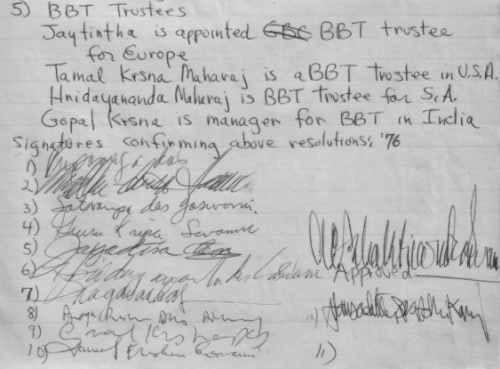
In 1975 Srila Prabhupada guided the GBC in the conduct of its first formal annual general meeting. He instituted parliamentary procedure, and in the first session he voted along with everyone else (to show how it is to be done). He caused the resolutions passed to be recorded by the secretary in an official minute book. He personally signed off on the resolutions passed (see Appendix X).
In that meeting, the fifth resolution record in the minute book repeals the provision for GBC election found in the Direction of Management:
“5) Resolved: The selection of GBC members is that Srila Prabhupada will nominate, and if there is a discrepancy, His Grace will change him. There will be no elections, and the present GBC member will remain.”
To underscore: “There will be no elections.”
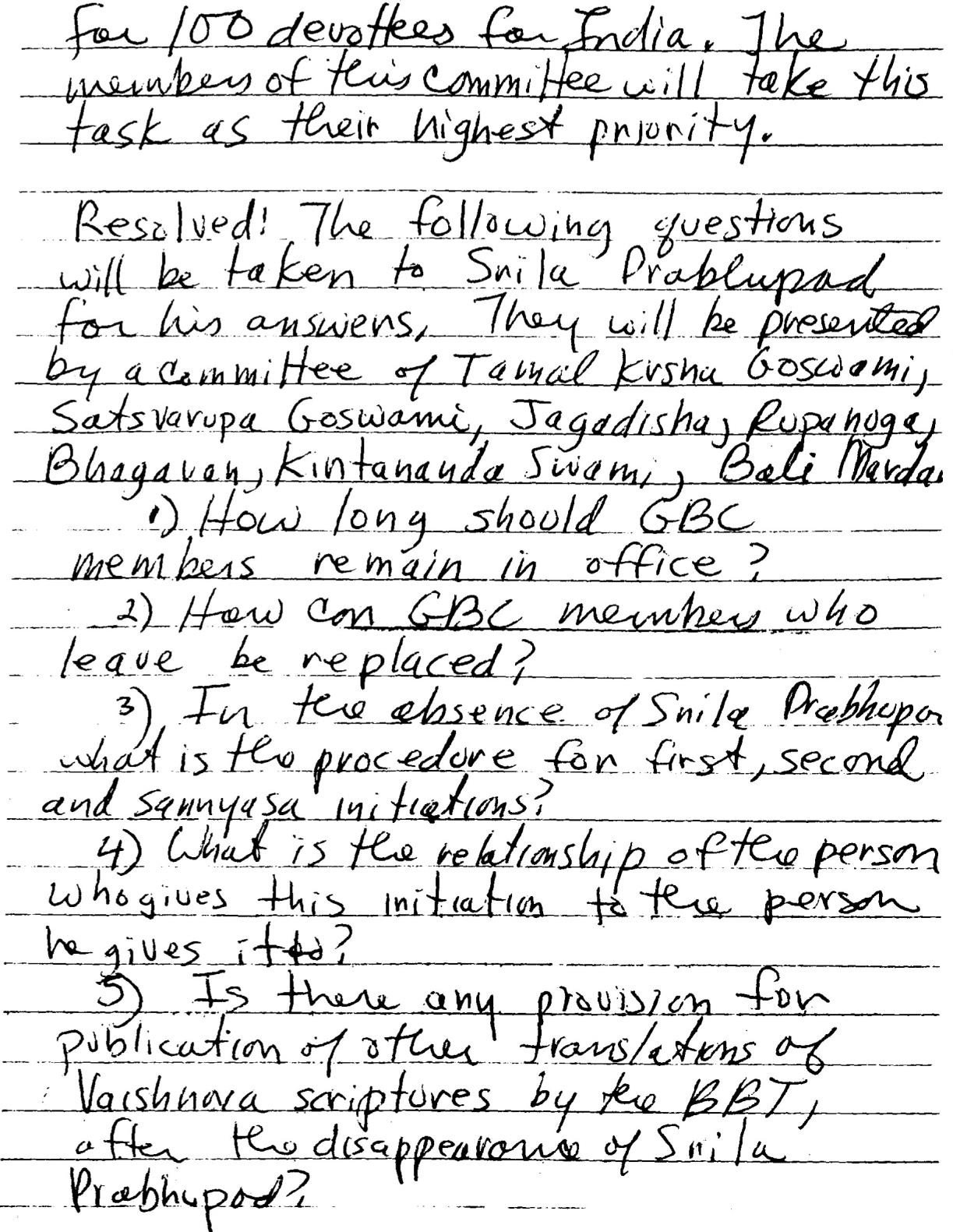
The same theme continued. On May 28th, 1977, an official delegation of the GBC, at Srila
Prabhupada’s request, met with Srila Prabhupada with questions for him about GBC, initiation, and translation in the future, particularly when Prabhupada would be no longer with us.
Here is the transcript of the relevant section of that taped conversation:
“Satsvarupa These are the members of the original GBC as you first made it up. So our first
question is about the GBC members. We want to know how long should they remain in office?
Prabhupada: They should remain for good.
Tamal Krsna: They should remain for good?
Prabhupada: Selected men are chosen, so they cannot be changed. Rather, if some competent man comes, he should be added. I shall recommend that Vasudeva become one of the GBC.
Tamala Krsna: Vasudeva is Deoji Punja. He’s the founder of our. He’s building the temple
in Fiji.
Prabhupada: How many GBCs are there already?
Tamala Krsna: Twenty-three.
Prabhupada: So add him. GBC is not to be changed.
Satsvarupa: But then, in the event that some present GBC member leaves, either leaves . . .
Prabhupada: Another should be elected.
Satsvarupa: By the votes of the present GBC.
The discussion then turns to the next topic. Some have found the above exchange inconclusive, because Prabhupada gives no explicit consent to the last statement of Satsvarupa (who expresses the GBC’s understanding of what Srila Prabhupada intended).
However, one must read the rest of the conversation. Characteristic of Srila Prabhupada’s pattern of giving clear instructions, at the end of the meeting, Srila Prabhupada reiterates the points he has made. Thus, he brings up the topic of GBC again:
Satsvarupa: That’s all the questions.
Prabhupada: So there is no question of changing GBC.
Satsvarupa: No.
Prabhupada: Rather, one who is competent, he can be selected to act by the board of the GBC.
Finally, in Srila Prabhupada “Declaration of Will,” dated June 1977, the
second provision contains the statement: “The system of management will continue as it is now and there is no need of any change.”
The simple truth is that if Srila Prabhupada had wanted to implement elections, he would have done so. There is strong evidence that Prabhupada was perfectly capable of imposing his will on his managers and leaders. He had proven himself quite able to deal effectively with an attempt to minimize his authority in 1970. There is also the example of him removing one of his top leaders from his powerful position and sending him to China. Frankly, the idea that Srila Prabhupada was unable to implement his intentions does not align with history.
Thus, we find that Srila Prabhupada never implemented the system of elections mentioned in the Direction of Management. Rather, within months of its drafting, Srila Prabhupada established selection of new GBC members by the existing members of the GBC alone. Srila Prabhupada continued to reaffirm this system up to and through his last will and testament.
(For more on this topic, see Appendix E.)
“Final”–“Ultimate”–“Supreme”– but not “Absolute”
A structure that gives final, ultimate, and supreme authority to the GBC may raise concerns about the possibility of a dictatorial or oppressive governance of ISKCON. Does the GBC possess absolute power that it can wield at its whim?
The role as “ultimate” or “final” authority does not mean the GBC has “absolute” authority. In fact, an essential element of Śrīla Prabhupāda’s instructions for the governance of ISKCON is that the GBC, both collectively and when acting as its individual members, must recognize and respect the dignity and rights of ISKCON’s officers and the devotees in general.
In his key directional letter to Karandhara dāsa, Śrīla Prabhupāda wrote:
“Krishna Consciousness Movement is for training men to be independently thoughtful and competent in all types of departments of knowledge and action, not for making bureaucracy. Once there is bureaucracy the whole thing will be spoiled. There must be always individual striving and work and responsibility, competitive spirit, not that one shall dominate and distribute benefits to the others and they do nothing but beg from you and you provide. . . .
“[O]ur leaders shall be careful not to kill the spirit of enthusiastic service, which is individual and spontaneous and voluntary. They should try always to generate some atmosphere of fresh challenge to the devotees, so that they will agree enthusiastically to rise and meet it. That is the art of management: to draw out spontaneous loving spirit of sacrificing some energy for Krishna. . . .
“Krishna Consciousness movement must be always a challenge, a great achievement to be gained by voluntary desire to do it, and that will keep it healthy.” [Letter to Karandhara, December 22, 1972]
Individuals, local leaders, and communities all working peacefully within ISKCON’s laws have an inherent, guaranteed right to perform their service without inappropriate, oppressive, or arbitrary interference. Since 1975, via resolutions made in Māyāpur, etc., ISKCON has developed a set of laws, standards, and appeals processes by which the GBC, other ISKCON leaders, and devotees in general are expected to conduct themselves. ISKCON, by Śrīla Prabhupāda’s design, is a society governed by established laws and guidelines.
Another check and balance is that the individual GBC members are under the full GBC. An individual GBC member does not carry the authority of the full GBC body and can be corrected, chastised, or removed by the full GBC if and when necessary.
A third check and balance desired by Śrīla Prabhupāda is a constitution for ISKCON. Completing this task has been assigned to the Constitutional Committee as part of the GBC’s strategic planning effort.
A fourth check and balance is a regular process of assessment and performance reviews of the individual GBC members. There is a standard being developed for GBC management, personal sadhana, understanding of siddhanta, and ability to counsel and inspire devotees. If a member of the GBC, even after training and guidance, is unable to come to the required standard, he or she will be required to serve in another, non-GBC capacity.
Confirmation of the scope of authority for the GBC
Nearing the end of his manifest pastimes, Śrīla Prabhupāda had a conversation, on June 2, 1977, with the devotees he had asked to create a draft for his last Will and Testament. Here is that conversation:
Girirāja: So we drafted a will. Should I read it?
Śrīla Prabhupāda: Hm?
Girirāja: Then we can type it. “I, A.C. Bhaktivedanta Swami Prabhupāda, Founder-Ācārya of the International Society for Krishna Consciousness, settler of the Bhaktivedanta Book Trust, and disciple of Oṁ Viṣṇupāda 108 Śrī Śrīmad Bhaktisiddhānta Sarasvatī Gosvāmī Mahārāja Prabhupāda, presently residing at Śrī Kṛṣṇa-Balarāma Mandir in Vṛndāvana, make this, my last Will. 1. The Governing Body Commission, GBC, will be the trustees of the entire International Society for Krishna Consciousness.”
Śrīla Prabhupāda: You can . . . Then there will be question, “The trust deed will be given? Then there will [be] tax.”
Girirāja: No, because the ISKCON trust is already there, and ISKCON is already tax exempt. The only difficulty is if you create a new trust.
Śrīla Prabhupāda: No, no new trust.
Girirāja: No.
Śrīla Prabhupāda: Instead of trustees . . .
Tamāl Krishna: Use a different word.
Śrīla Prabhupāda: Ah. Rāmeśvara: Not to apply in trust. Girirāja: Oh, I see.
Rāmeśvara: It’s a different word.
Śrīla Prabhupāda: Supreme managers.
Gopāla Kṛṣṇa: Supreme managers.
Śrīla Prabhupāda: Or the ultimate managers, like that.
Gopāla Kṛṣṇa: The ultimate executives?
Śrīla Prabhupāda: Yes.
Tamāl Krishna: Yes, the executors.
Gopāla Kṛṣṇa: Ultimate executors.
Tamāl Krishna: Or commissioners. You have . . .
Śrīla Prabhupāda: Hm. Yes, commissioners.
Tamāl Krishna: Commissioner is good, ’cause it’s already . . .
Śrīla Prabhupāda: Use such word.
Tamāl Krishna: Use a word that’s proper.
In its final form, signed by Śrīla Prabhupāda, the Will used the words “ultimate managing authority.” The conversation above confirms the scope of authority Śrīla Prabhupāda intended for the GBC. It is clear by his using terms like “ultimate” and “supreme” that he intended the GBC to be the final management body over the entirety of ISKCON: a decision-making body that no other entity, body, or individual could equal or surpass.
Cooperation / “Unity in Diversity”
In the effort to lay out the GBC’s role as ISKCON’s ultimate managing authority, let us not forget Śrīla Prabhupāda’s direction that his followers work together in a mood of mutual respect and cooperation.
“Now we are growing, and if we work cooperatively, our strength will also grow, and then the mission will not be checked in its progress.” [Letter to Candanācārya, March 12th, 1970]
“I thank you very much, all of you, for appreciating my humble service which I am trying to render as a matter of duty ordered by my Guru Maharaja. I request all my disciples to work cooperatively and I am sure our mission will advance without any doubt.” [Letter to Tamāl Krishna, August 14, 1971]
“Good manager means he is able to satisfy everyone and live in cooperative manner with all the devotees, so if you manage things nicely [every devotee] can do tremendous work” [Letter to Girirāja, May 2, 1972]
“Now, we have by Krsna’s Grace built up something significant in the shape of this ISKCON and we are all one family. Sometimes there may be disagreement and quarrel but we should not go away. These inebrieties can be adjusted by cooperation, tolerance and maturity… The test of our actual dedication and sincerity to serve the Spiritual Master will be in this mutual cooperation to push on this Movement.” [Letter to Babhru, December 9, 1973]
Always with an eye for how to make the philosophical a practical reality, Śrīla Prabhupāda wrote the following:
“If we keep Krsna in the center, then there will be agreement in varieties. This is called unity in diversity. I am therefore suggesting that all our men meet in Mayapur every year during the birth anniversary of Lord Chaitanya Mahaprabhu. With all GBC and senior men present we should discuss how to make unity in diversity.” [Letter to Kīrtanānanda, October 18, 1973]
It is clear that Śrīla Prabhupāda wanted and expected the GBC and all the members of ISKCON to deal with each other in a humble, respectful, and cooperative spirit.
“We must be very careful to maintain unity in diversity and remember the story in
Aesop’s Fables of the father of many children with the bundle of sticks. When the father asked his children to break the bundle of sticks wrapped in a bag, none of them could do it. But, when they removed the sticks from the bag, and tried one by one, the sticks were easily broken. So this is the strength in unity. If we are bunched up, we can never be broken, but when divided, then we can become broken very easily.” [Letter to Kīrtanānanda, October 18, 1973]
Summary
This paper’s review of the historical record establishes the following:
- The structure of management for ISKCON, carefully put into place by Śrīla Prabhupāda, was of a governing body that serves as the ultimate managing authority.
- Śrīla Prabhupāda wanted the GBC to “handle management, questions of philosophy and personal problems.” He expected his GBC members to oversee “the preaching work” and to be sure that a high standard of spiritual “purity” is maintained throughout ISKCON. Simultaneously, he ordered them to monitor the Society’s “financial matters.” He wrote: “GBC means to be occupied with everything and anything in the zone.”
- Assuming that the GBC body acts within the guidelines of ISKCON’s laws and the standards he set, Śrīla Prabhupāda expected the devotees to follow the decisions of the GBC.
- Spiritual authority alone was not always enough. Śrīla Prabhupāda worked hard to make sure that he also had legal control, with the GBC serving as his agents. With his physical departure, Śrīla Prabhupāda, via his Will, indicated that he wanted the GBC to have the legal means to protect the assets of the Society, especially property.
- “Ultimate managing authority” means in all spheres of ISKCON’s activities: philosophical, spiritual, administrative, etc. To Śrīla Prabhupāda, all of these activities were spiritual. “After all, it is Krishna’s establishment.”
- The GBC members are not simply administrators but are also expected to establish, exemplify, and safeguard spiritual standards and siddhānta.
- Although different corporations may be needed in order to meet local legal standards, all of these corporations are meant to follow the direction of the GBC.
- GBC members are meant “to serve for good . . . assuming they are fit.” New and replacement members are to be selected by the existing GBC members.
- Ultimate and final authority does not mean absolute authority. Śrīla Prabhupāda intended ISKCON to be a Society governed by laws and a code of ethics. He intended there to be a constitution in place that protects the individual members and the officers of ISKCON.
- These principles will only be effective if practiced in a humble, respectful, and cooperative spirit. It also assumes the GBCs’ fidelity to Śrīla Prabhupāda’s vāṇī, their practice of strong sādhana, and the on-going training and assessment of the performance of ISKCON’s leadership, including the GBC.
Conclusion
This paper closes as it began—with Śrīla Prabhupāda in Vṛndāvana. However, this time, instead of being “a lone fighter,” he is the world-renowned founder-ācārya of ISKCON. He has opened over 108 temples, farms, schools, restaurants, and preaching centers. He is the author of dozens of books recognized by scholars around the world. He is surrounded by loving disciples. Śrīla Prabhupāda is in the quiet of his home in Vṛndāvana, manifesting his last pastimes and preparing to leave this world.
Devotees asked Śrīla Prabhupāda if he was departing as his own spiritual master did, frustrated with his disciples. Śrīla Prabhupāda said, “No.” Rather he said that he was very pleased with them and how they were carrying on the missionary work.
The following confirms Śrīla Prabhupāda’s mood.
“The G.B.C. held meetings and established a committee with Rāmeśvara, Jayapatāka, Girirāja, Gopāla Kṛṣṇa, Jayatīrtha and myself to form trust properties of all India holdings. A trust deed was drafted, based on the BBT document, and read to His Divine Grace. Prabhupāda was very satisfied and said, ‘Jaya future directors of ISKCON.’ And later he said, ‘Now I can die peacefully.’” [TKG’s Diary, May 27, 1977] and [Lilamrita / Chapter 52]
Here is an entry from the next day:
“Later in the morning Yaśodānandana Mahārāja offered a prayer in this same vein and Prabhupāda said ‘I have no objection. I like your association, and at all our temples it is like Vaikuṇṭha. My Guru Mahārāja left very dissatisfied, but I am not at all.’” [TKG’s Diary, May 28, 1977]
During this period Śrīla Prabhupāda completed and signed his Will. In the very first clause, where one traditionally names the beneficiary or successor, Śrīla Prabhupāda put his GBC.
“The Governing Body Commission (GBC) will be the ultimate managing authority of the entire International Society for Krishna Consciousness.”
Thus, knowing that he was signing a document that would serve as his last Will and Testament, that it would stand as the historical and legal record to execute his intent, Śrīla Prabhupāda referred to the GBC as “the ultimate managing authority”—and that this ultimate authority was intended by him to be over “the entire International Society for Krishna Consciousness.” (Emphasis added.)
Here we have Śrīla Prabhupāda, in his last instructions to his followers and to the world, confirming the system he began in 1970 and spent so many years carefully, lovingly, and strongly establishing.
(See Appendix D for the full text of Śrīla Prabhupāda’s will). It was asked at the beginning of this paper:
“Srila Prabhupada’s vision, the re-manifestation of his spiritual master’s own vision, was of a vibrant society, with many strong personalities all working under the umbrella of the same institution. Srila Prabhupada meditated long and hard on how to keep his new society united. How in the future, when there would be many powerful personalities with their myriad projects and followers, to keep them all under the same umbrella? How to avoid the party spirit of the single acharya view that so ravaged the Gaudiya Math? How to have a firm yet flexible structure that allows for unity in diversity?”
Śrīla Prabhupāda’s answer was to establish the GBC system. It is the thread running throughout the fabric of ISKCON, serving to unite while at the same time allowing for diversity. It allows the flexibility for there to be many strong leaders and varied projects and initiatives all within the same institution. The uniting feature of that structure is that ultimately all these individuals, projects, and programs are under the final authority and directions of the GBC. Remove this GBC thread, and Śrīla Prabhupāda’s vision of a unified ISKCON unravels.
As Śrīla Prabhupāda said just nine days before his departure:
“The institution depends on the GBC.” [Room conversation, November 5, 1977] In his final few days Śrīla Prabhupāda appealed to all of his followers:
“Your love for me will be tested [by] how after my departure you maintain this institution.” [TKG’s Diary, May 23, 1977 / confirmed by Bhakti Chāru Mahārāja]
Following Śrīla Prabhupāda’s GBC system is both a gift and a test given to us by His Divine Grace. Doing so is essential to sustain ISKCON as one institution, to keep it under the shelter of Śrīla Prabhupāda’s instructions, in line with his transcendental vision, and powerfully delivering the mercy of Sri Sri Gaura-Nitai to the world.
List of appendices
- Direction of Management
- “Topmost Urgency” memo
- Oath of Allegiance
- Śrīla Prabhupāda’s Will
- GBC Minutes from meetings in Vṛndāvana on May 27 and May 28, 1977.
- Copy of GBC resolutions from
(end)
“Conditional Approval Pending Review and Advisement by Legal Counsel”
Appendix A
Establishment of the GBC – Direction of Management, July 28, 1970:
INTERNATIONAL SOCIETY FOR KRISHNA CONSCIOUSNESS, INCORPORATED FOUNDER-ACHARYA: HIS DIVINE GRACE
A.C. BHAKTIVEDANTA SWAMI PRABHUPADA DIRECTION OF MANAGEMENT
I, the undersigned, A.C. Bhaktivedanta Swami, disciple of Om Visnupad Paramhansa 108 Sri Srimad Bhaktisiddhanta Sarasvati Gosvami Maharaj Prabhupada, came in the United States in 1965 on September 18th for the purpose of starting Krishna Consciousness Movement. For one year I had no shelter. I was travelling in many parts of this country. Then in 1966, July, I incorporated the Society under the name and style the International Society for Krishna Consciousness, briefly ISKCON. The lawyer was Mr. J. Goldsmith. Gradually the Society increased, and one after another branches were opened. Now we have got thirty-four
(34) branches enlisted herewith:
Amsterdam, Holland
Atlanta, Georgia 1476 Oxford Rd. N.E. 30322 Baltimore, Maryland 1300 N. Calvert St.
Berkeley, California 2710 Durant Avenue 94704 Berlin, West Germany
Boston, Massachusetts 40 N. Beacon St. 02134 Boulder, Colorado 623 Concord St.
Buffalo, New York 40 Englewood Ave. 14214 Chicago, Illinois 2210 N. Halstead St.
Columbus, Ohio 318 East 20th Ave. 43201 Detroit, Michigan 74 West Forest St. 48201 Edinburgh, Scotland, U.K.
Hamburg, West Germany 2000 Hamburg 6, Bartelstrasse 65
Honolulu, Hawaii 2016 McKinley St. 96822
Laguna Beach, California 130 Woodland Drive 92651 London, England 7 Bury Place, Bloomsbury, W.C. 1
Los Angeles, California 3764 Watseka Ave. 90034 Montreal, Canada 3720 Park Ave.
New Vrndavana, W. Virginia RD 3 Moundsville 26041 New York City, New York 61 Second Ave. 10003 Paris, France c/o Serge Elbeze, BO 113 Paris 14 Philadelphia, Pennsylvania 416 South 10th St. 19147 Provincetown, Massachusetts104 Bradford St.
San Diego, California 3689 Park Blvd.
San Francisco, California618 Frederick St. 94117 San Jose, California 70 Hawthorne Way
Santa Barbara, California 6654 del Playa, Goleta 93017 Seattle, Washington n5516 Roosevelt Way N.E. 98105 St. Louis, Missouri 4544 LaClede Ave. 63110
Sydney, Australia 298 Birrell St. Bondi, N.S.W. 2026 Tokyo, Japan 6-16, 2 Chome Ohhashi, Meguro-Ku Toronto, Canada 40 Beverly St., Ontario
Vancouver, Canada 260 Raymur St., No. 305, B.C. Washington, D.C.2015 Q Street N.W. 20009
As we have increased our volume of activities, now I think a Governing Body Commission (hereinafter referred to as the GBC) should be established. I am getting old, 75 years old, therefore at any time I may be out of the scene, therefore I think it is necessary to give instruction to my disciples how they shall manage the whole institution. They are already managing individual centers represented by one president, one secretary and one treasurer, and in my opinion they are doing nice. But we want still more improvement in the standard of Temple management, propaganda for Krishna Consciousness, distribution of books and literatures, opening of new centers and educating devotees to the right standard. Therefore, I have decided to adopt the following principles and I hope my beloved disciples will kindly accept them.
There was a meeting in San Francisco during the Ratha Yatra festival 1970 and many presidents of the centers were present. In that meeting it was resolved that an ad hoc committee be set up to form the constitution which is taken into consideration. My duty was to first appoint twelve (12) persons to my free choice amongst my disciples and I do it now and their names are as follows:
- Sriman Rupanuga Das Adhikary
- Sriman Bhagavandas Adhikary
- Sriman Syamsundar Das Adhikary
- Sriman Satsvarupa Das Adhikary
- Sriman Karandhar Das Adhikary
- Sriman Hansadutta Das Adhikary
- Sriman Tamala Krsna Das Adhikary
- Sriman Sudama Das Adhikary
- Sriman Bali Mardan Das Brahmacary
- Sriman Jagadisa Das Adhikary
- Sriman Hayagriva Das Adhikary
- Sriman Krsnadas Adhikary
These personalities are now considered as my direct representatives. While I am living they will act as my zonal secretaries and after my demise they will be known as Executors.
I have already awarded Sannyas or the renounced order of life to some of my students and they have also got very important duties to perform in this connection. The Sannyasis will travel to our different centers for preaching purpose as well as enlightening the members of the center for spiritual advancement. The Sannyasis will suggest for opening new centers in suitable places and the GBC will take action on it.
As was stipulated by the ad hoc committee, the function of the GBC will be as follows with particulars:
PARTICULARS OF THE GOVERNING BODY COMMISSION
“The purpose of the Governing Body Commission is to act as the instrument for the execution of the Will of His Divine Grace. And further,
- The GBC oversees all operations and management of ISKCON, as it receives direction from Srila Prabhupada and His Divine Grace has the final approval in all matters.
- His Divine Grace will select the initial 12 members of the GBC. In the succeeding years the GBC will be elected by a vote of all Temple presidents who will vote for 8 from a ballot of all Temple presidents, which may also include any secretary who is in charge of a Temple. Those 8 with the greatest number of votes will be members for the next term of GBC. Srila Prabhupada will choose to retain four commissioners. In the event of Srila Prabhupada’s absence, the retiring members will decide which four will remain.
- The commissioners will serve for a period of 3 years, and they may be re-elected at the end of this period.
- The chairman is elected by the GBC for each meeting. He has no veto power, but in even of a vote tie, his vote will decide. The same will apply for votes cast by mail between regular meetings.
- Throughout the year, each of the commissioners will stay with His Divine Grace for one month at a time and keep the other commissioners informed of His Divine Grace’s instructions.
- The primary objective of the GBC is to organize the opening of new Temples and to maintain the established Temples.
- Advice will be given by the GBC in cases of real property purchases, which will be in
the name of ISKCON, INC. (Trucks or other vehicles will be purchased in the name of the local president).
- Removal of a Temple president by the GBC requires support by the local Temple members.
- The GBC has no jurisdiction in the publication of manuscripts, which will be handled by a separate committee; profits to be returned to Srila Prabhupada.”
So far my books are concerned, I am setting up a different body of management known as the BHAKTIVEDANTA BOOK TRUST. The trustees of this body are also members of the GBC, but their function is not dependent on the GBC.
ISKCON Press was created for the exclusive publication of my books and literatures and should be continued in that way.
During my absence no one shall live in my apartment. ACB
A.C. Bhaktivedanta Swami
Witnessed by:
Date July 28th 1970 (Robert F. Corens) Rupanuga das Adhikary (William R. Ehrlichman) Bhagavan das Adhikary (Kelly Gifford Smith) Karandhar das Adhikary Date July 28th, 1970
At the World Head Quarters 3764, Watseka Avenue
Los Angeles, California 90034
Appendix B
TOPMOST URGENCY
AMENDMENTS TO BE IMMEDIATELY ADDED TO ALL OFFICIAL REGISTRATION DOCUMENTS, CONSTITUTIONS, INCORPORATION PAPERS, ETC.
- It is declared that His Divine Grace A.C. Bhaktivedanta Swami Prabhupada is the Founder-Acharya of (ISKCON) International Society for Krishna Consciousness. He is the supreme authority in all matters of the society. His position cannot be occupied by anyone else, and his name and title must appear on all documents, letterheads, publications, and buildings of the Society.
In particular it shall be clearly understood that no real estate may be purchased or sold by any officer of the Society without the express permission of His Divine Grace
A.C. Bhaktivedanta Swami Prabhupada, the Founder-Acharya of ISKCON.
- There shall be a Governing Board Committee of trustees appointed by the
Founder-Acharya His Divine Grace A.C. Bhaktivedanta Swami Prabhupada according to the document Direction of Management dated July 28, 1970. The GBC is to act as the instrument for the execution of the will of His Divine Grace Srila Prabhupada.
Dated at New York, July 22, 1974.
Approved: A.C. Bhaktivedanta Swami, Founder-Acharya Signed: Brahmananda Swami, GBC, Zonal Secretary Balimardan das Goswami GBC, Zonal Secretary
Appendix C
Note: This is the current version of the Oath (from the 1996 Mayapur meeting resolutions).
5.4.2.1 Statement of Oath The oath shall be as follows:
- To accept His Divine Grace A.C. Bhaktivedanta Swami Prabhupada
as the Founder-Acharya and Supreme Authority of ISKCON. To follow his teachings, instructions and directions.
- To accept the Governing Body Commission of ISKCON as the ultimate managing authority of ISKCON as directed in Srila Prabhupada’s last will and testament.
- To abide by the Society’s spiritual rules, namely no illicit sex, no intox-ication, no gambling, no meat-eating and chant a minimum of sixteen rounds of maha-mantra japa every day. To follow the principles set forth in Srila Prabhupada’s books.
- To accept that all ISKCON’s funds, assets and properties under my control or direction, including anything ISKCON may have acquired under my
direction,
is the sole property of ISKCON and in the event of my death, resignation or other relinquishment of all ISKCON responsibilities, all these shall accrue solely to ISKCON and at all times I shall have no claim on them whatsoever.
- To be guided by the spiritual directions of ISKCON’s management, to co-operate with the local GBC representative, and to fulfill my duties in a serving spirit never intentionally acting against ISKCON’s interests.
- I will maintain the spiritual programs, standards, and teachings established by Srila Prabhupada in the projects and with the devotees placed in my care.
I
further agree not to involve the Society or those devotees placed under my
care
in any activities contrary to the above mentioned principles.
This resolution shall override and replace all previous legislation on oaths for ISKCON leaders. This doesn’t replace the additional oath that ISKCON gurus must also take.
Appendix D
CENTER: Krsna-Balarama Mandir, Bhaktivedanta Swami Marg, Ramanareti, Vrndavana, U.P.
DATE: June 1977
DECLARATION OF WILL
I, A.C. Bhaktivedanta Swami Prabhupada, founder-acarya of the International Society for Krishna Consciousness, Settlor of the Bhaktivedanta Book Trust, and disciple of Om Visnupada 108 Sri Srimad Bhaktisiddhanta Sarasvati Gosvami Maharaj Prabhupada, presently residing at Sri Krsna-Balarama Mandir in Vrndavana, make this my last
will:
- The Governing Body Commission (GBC) will be the ultimate managing authority of the entire International Society for Krishna Consciousness.
- Each temple will be an ISKCON property and will be managed by three executive directors. The system of management will continue as it is now and there is no need of any change.
-
Properties in India will be managed by the following executive directors:
- Properties at Sri Mayapur Dhama, Panihati, Haridaspur and Calcutta: Gurukrpa Swami, Jayapataka Swami, Bhavananda Gosvami and Gopal Krsna das Adhikari.
- Properties at Vrndavana: Gurukrpa Swami, Akshoyananda Swami, and Gopal Krsna das Adhikari.
- Properties at Bombay: Tamal Krsna Gosvami, Giriraj das Brahmachary, and Gopal Krsna das Adhikari.
- Properties at Bhuvanesvara: Gour Govinda Swami, Jayapataka Swami, and Bhagawat das Brahmachary.
- Properties at Hyderabad: Mahamsa Swami, Sridhar Swami, Gopal Krsna das Adhikari and Bali Mardan das Adhikari.
- The executive directors who have herein been designated are appointed for life. In the event of the death or failure to act for any reason of any of the said directors, a successor director or directors may be appointed by the remaining directors, pro-vided the new director is my initiated disciple following strictly all the rules and regulations of the International Society for Krishna Consciousness as detailed in my books, and provided that there are never less than three (3) or more than five (5) executive directors acting at one time.
- I have created, developed, and organized the International Society for Krishna Consciousness, and as such I hereby will that none of the immovable properties standing in the name of ISKCON in India shall ever be mortgaged, borrowed against, sold, transferred, or in any way encumbered, disposed of, or alienated. This direction is irrevocable.
- Properties outside of India in principle should never be mortgaged, borrowed against, sold, transferred or in any way encumbered, disposed of, or alienated, but if the need arises, they may be mortgaged, borrowed against, sold, etc., with the consent of the GBC committee members associated with the particular property.
-
The properties outside of India and their associated GBC committee members are as follows:
- Properties in Chicago, Detroit and Ann Arbor: Jayatirtha das Adhikari, Harikesa Swami, and Balavanta das Adhikari.
- Properties in Hawaii, Tokyo, Hong Kong: Guru Krpa Swami, Rameswara Swami, and Tamal Krsna Gosvami.
- Properties in Melbourne, Sydney, Australia Farm: Guru Krpa Swami, Hari Sauri, and Atreya Rsi.
- Properties in England (London Radlett), France, Germany, Netherlands, Switzerland and Sweden: Jayatirtha das Adhikari, Bhagavan das Adhikari, Harikesa Swami.
- Properties in Kenya, Mauritius, South Africa: Jayatirtha das Adhikari, Brahmananda Swami and Atreya Rsi.
- Properties in Mexico, Venezuela, Brazil, Costa Rica, Peru, Ecuador, Colombia, Chile: Hrdayananda Gosvami, Panca Dravida Swami, Brahmananda Swami.
- Properties in Georgetown, Guyana, Santo Domingo, St. Augustine: Adi Kesava Swami, Hrdayananda Gosvami, Panca Dravida Swami.
- Properties in Vancouver, Seattle, Berkeley, Dallas: Satsvarupa Gosvami, Jagadisa das Adhikari, Jayatirtha das Adhikari.
- Properties in Los Angeles, Denver, San Diego, Laguna Beach: Rameswara Swami, Satsvarupa Swami, Adi Kesava Swami.
- Properties in New York, Boston, Puerto Rico, Port Royal, St. Louis, St. Louis Farm: Tamal Krsna Gosvami, Adi Kesava Swami, Rameswara Swami.
- Properties in Iran: Atreya Rsi, Bhagavan das Adhikari, Brahmananda Swami.
- Properties in Washington D.C., Baltimore, Philadelphia, Montreal and Ottawa: Rupanuga das Adhikari, Gopal Krsna das Adhikari, Jagadisa das Adhikari.
- Properties in Pittsburgh, New Vrndavana, Toronto, Cleveland, Buffalo: Kirtanananda Swami, Atreya Rsi, Balavanta das Adhikari.
- Properties in Atlanta, Tennessee Farm, Gainesville, Miami, New Orleans, Mississippi Farm, Houston: Balavanta das Adhikari, Adi Kesava Swami, Rupanuga das Adhikari.
- Properties in Fiji: Hari Sauri, Atreya Rsi, Vasudev.
- I declare, say and confirm that all the properties, both movable and immovable, which stand in my name, including current accounts, savings accounts and fixed deposits in various banks, are the properties and assets of the International Society for Krishna Consciousness, and the heirs and successors of my previous life, or anyone claiming through them, have no right, claim or interest in these properties watsoever, save and except as provided hereafter.
- Although the money which is in my personal name in different banks is being spent for ISKCON and belongs to ISKCON, I have kept a few deposits specifically marked for allocating a monthly allowance of Rs. 1,000/- each to the members of my former family (two sons, two daughters, and wife). After the deaths of the members of my former family, these specific deposits (corpus, interests, and savings) will become the property of ISKCON for the corpus of the trust, and the descendants of my former family or anybody claiming through them shall not be allowed any further allowance.

- I hereby appoint Guru Krpa Swami, Hrdayananda Gosvami, Tamal Krishna Svami, Rameshwar Swami, Gopal Krishna das Adhikari, Jayatirtha das Adhikari and Giriraj das Brahmachary to act as executors of this will. I have made this will this 4th day of June, 1977, in possession of full sense and sound mind, without any persua-sion, force or compulsion from anybody.
Witnesses:
1. (?)
- Tamal Krishna Goswami
- Bhagavandas Adhikary
(signed)
A.C. Bhaktivedanta Swami
Appendix E
From GBC Minutes book / May 28th, 1977
The following is from the GBC minutes of May 28, 1977, entered just before andjust after the conversation. The first entry records the questions the GBC gave the sub-committee to ask Srila Prabhupada; the second, the GBC’s understanding ofPrabhupada ‘s reply. Eighteen GBC members immediately understood and accepted that Srila Prabhupada expected his disciples to become diksa gurus after his departure. Not one of them had any inkling of any posthumous ritvik notion.
 Appendix F
Srila Prabhupada’s signature certifying GBC resolutions of 1976